Inventory may look simple on a stock report: SKU, quantity, and location.
But inside a warehouse, not all inventory behaves the same way.
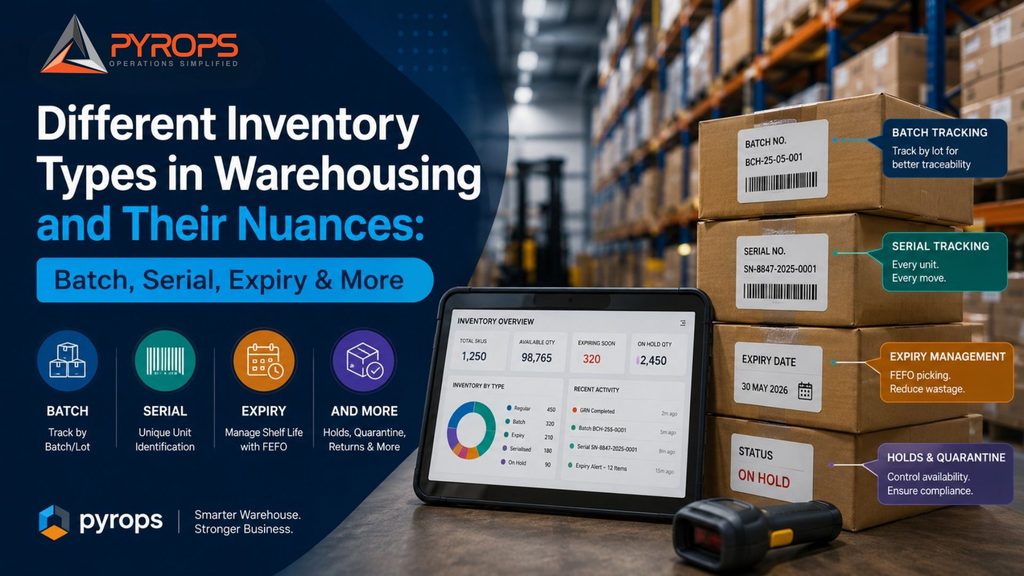
A box of generic office supplies can often be picked and moved with minimal controls. A pharmaceutical product may need batch and expiry tracking. A smartphone may need individual serial number tracking. Food products may require FEFO picking based on shelf life.
This is why effective warehouse management is not just about knowing how much stock you have. It is about knowing what type of stock you have, how it needs to be handled, and what information must stay attached to it throughout its lifecycle.
A modern WMS such as Pyrops can manage multiple inventory types and apply the appropriate controls to each, from regular inventory to batch-controlled, expiry-controlled, and serialised inventory.
1. Regular Inventory: Simple, but Still Needs Accuracy
Regular inventory is the most straightforward type of inventory.
These are products where individual unit identity, batch information, or expiry dates are generally not critical to warehouse operations. Examples can include general merchandise, certain industrial supplies, packaging materials, and other non-sensitive products.
What makes it different?
The primary focus is usually:
- Accurate quantity
- Correct SKU identification
- Location visibility
- Efficient putaway and picking
- Stock replenishment
- Inventory reconciliation
For example, if a warehouse has 500 units of a standard product, the primary question is simply:
How many are available, and where are they?
However, “simple” does not mean “uncontrolled.” Every movement still needs to be accurately recorded to prevent stock discrepancies, misplaced inventory, and incorrect order fulfilment.
2. Batch-Controlled Inventory: When Groups of Products Matter
Batch-controlled inventory is managed based on a common batch or lot number.
Products belonging to the same batch typically share characteristics such as production date, manufacturing source, or other traceability information.
This is particularly important in industries such as:
- Pharmaceuticals
- Food and beverage
- FMCG
- Chemicals
- Manufacturing
The key nuance: inventory is no longer just SKU-level
Suppose a warehouse has:
SKU A — 10,000 units
That number alone may not be enough.
The actual inventory could be:
- Batch A — 3,000 units
- Batch B — 4,000 units
- Batch C — 3,000 units
The warehouse needs to know not only the total quantity but also which batch is stored where and which batch should be picked.
Why batch traceability matters
If a quality issue is identified in Batch B, the warehouse should be able to determine:
- How much stock from Batch B remains?
- Where is it currently stored?
- Which customers received it?
- When was it received?
- What other warehouse movements occurred?
This is where forward and backward lot traceability becomes important. Pyrops supports batch-level traceability and maintains movement history across warehouse operations.
3. Expiry-Controlled Inventory: When Time Becomes a Constraint
Expiry-controlled inventory adds another dimension to inventory management: time.
For these products, having stock available is not enough. The stock must still have sufficient usable shelf life.
Examples include:
- Food products
- Pharmaceuticals
- Cosmetics
- Certain chemicals
- Perishable FMCG products
Consider two batches of the same product:
Batch A: Expires in 15 days
Batch B: Expires in 8 months
If the warehouse simply picks whichever batch is easiest to access, Batch A could remain in storage until it expires.
That creates:
- Inventory write-offs
- Disposal costs
- Lost margins
- Potential compliance issues
- Customer dissatisfaction
FEFO vs FIFO
This is where the distinction between FIFO and FEFO becomes important.
FIFO — First In, First Out
The stock received first is picked first.
FEFO — First Expiry, First Out
The stock with the earliest expiry date is picked first.
For expiry-sensitive products, FEFO can be more appropriate because the oldest received stock is not necessarily the stock that expires first.
Pyrops supports configurable FIFO, FEFO, and FMFO rules and can direct picking based on the applicable inventory strategy.
Expiry management goes beyond picking
A robust expiry-control process should also provide:
- Batch-level expiry visibility
- Near-expiry alerts
- Shelf-life controls
- Automatic identification of non-pickable stock
- Quarantine workflows
- Customer-specific shelf-life requirements where applicable
Pyrops can track shelf life at the batch level, surface near-expiry stock, and remove stock from the pickable pool once configured thresholds are crossed.
4. Serialised Inventory: Every Unit Has an Identity
Serialised inventory is fundamentally different from batch inventory.
With batch tracking, several units can share the same batch identity.
With serialisation, every individual unit has its own unique identity.
For example:
- Laptop — Serial No. X12345
- Laptop — Serial No. X12346
- Laptop — Serial No. X12347
Even though all three may belong to the same SKU, each unit needs to be tracked independently.
Where is serialisation important?
Serialised inventory is common in:
- Electronics
- Mobile devices
- Industrial equipment
- Medical devices
- High-value products
- Assets requiring warranty tracking
The warehouse may need to know exactly:
Where is serial number X12345 right now?
But that is only one part of the requirement.
It may also need to know:
- When was it received?
- Which supplier shipped it?
- Which batch did it belong to?
- Where was it stored?
- When was it dispatched?
- Which customer received it?
- Was it returned?
- Did it go through QC or refurbishment?
Pyrops captures serial numbers at inbound and tracks them through putaway, transfers, picking, packing, and dispatch.
5. Batch + Serial: When Both Levels Matter
In some operations, inventory is not simply batch-controlled or serial-controlled.
It can be both.
A batch may contain hundreds or thousands of individual serialised units.
For example:
Batch B2026-08
→ Device 001
→ Device 002
→ Device 003
→ Device 004
→ …and so on.
The batch provides group-level context, while the serial number provides individual-unit identity.
This combination becomes especially valuable in electronics and other industries where businesses need both:
Lot-level traceability + unit-level traceability.
Pyrops supports both simultaneously, allowing individual serialised units to retain their batch context throughout the warehouse lifecycle.
6. Inventory Holds and Quarantine: Stock That Exists but Cannot Be Picked
Not all inventory physically present in a warehouse is necessarily available for sale or consumption.
Stock may need to be placed on hold because of:
- Quality inspection
- Damage
- Regulatory concerns
- Customer-specific restrictions
- Expiry concerns
- Returns processing
- Investigation of a discrepancy
This creates an important distinction:
Physical inventory ≠ Available inventory
A warehouse may physically contain 1,000 units, while only 850 are actually available for allocation.
A WMS needs to distinguish between these states so that restricted inventory does not accidentally get allocated or dispatched.
Pyrops supports inventory holds and quarantine workflows as part of its warehouse execution capabilities.
7. Why the Inventory Type Changes the Warehouse Workflow
The biggest mistake is to think that inventory types are simply different labels in a system.
They actually change how warehouse operations need to be executed.
Consider receiving.
For regular inventory, the process might simply be:
Receive → Count → Put Away
For batch-controlled inventory:
Receive → Capture Batch → Verify → Put Away
For expiry-controlled inventory:
Receive → Capture Batch & Expiry → Validate Shelf Life → Put Away
For serialised inventory:
Receive → Scan Serial Numbers → Validate → Register → Put Away
The same principle applies to picking.
Regular inventory may require SKU and quantity validation.
Batch inventory requires batch validation.
Expiry-controlled inventory may require FEFO selection.
Serialised inventory requires unit-level identification.
That is why inventory control cannot be separated from warehouse execution.
8. The Role of a WMS in Managing These Differences
The purpose of a WMS is not simply to digitise a warehouse register.
It should translate inventory rules into operational workflows.
For example, instead of relying on a picker to remember which batch should be selected, the system can direct the picker to the appropriate inventory.
Instead of manually entering serial numbers, serialised products can be captured through barcode or QR scanning.
Instead of discovering expired stock during a periodic physical check, the system can surface approaching expiry and restrict stock based on configured rules.
Pyrops uses scan-enforced workflows to capture inventory information at the point of movement, while supporting batch, serial, expiry, FIFO, FEFO, and other inventory controls.
9. One Warehouse, Multiple Inventory Rules
The real complexity begins when a warehouse handles multiple inventory types simultaneously.
A single facility could contain:
- Regular inventory
- Batch-controlled products
- Expiry-controlled products
- Serialised devices
- Quarantined stock
- Returned inventory
- Refurbishment inventory
Each may require different rules.
The warehouse team therefore needs a system that can apply the right control to the right inventory, rather than forcing every product through the same process.
This is where configurable warehouse workflows become important.
The goal is not to make every inventory type complicated.
The goal is to make the complexity invisible to the warehouse operator while ensuring that the right rules are enforced in the background.
10. Choosing the Right Inventory Control
There is no single “best” inventory type.
The right control depends on the nature of the product and the risks associated with losing its identity or history.
| Inventory Type | Primary Control | Typical Use Cases |
|---|---|---|
| Regular | SKU & quantity | General merchandise |
| Batch | Lot/batch identity | FMCG, pharma, chemicals |
| Expiry | Shelf life & expiry date | Food, pharma, cosmetics |
| Serialised | Individual unit identity | Electronics, devices, equipment |
| Batch + Serial | Lot + unit identity | High-value/regulated products |
| Hold/Quarantine | Availability status | QC, returns, damaged stock |
The important question for warehouse leaders is therefore not simply:
“How much inventory do we have?”
It is:
“What inventory do we have, what controls does it require, and can we trace every movement accurately?”
Conclusion: Inventory Visibility Must Go Beyond Quantity
Modern warehouses are managing increasingly diverse products and increasingly complex fulfilment requirements.
A reliable inventory system needs to understand that a SKU is not always just a SKU.
Sometimes it represents a batch.
Sometimes it represents a shelf-life window.
Sometimes it represents an individual serialised unit.
And sometimes it represents all three at once.
The difference lies in the controls applied at every stage—from receiving and putaway to picking, dispatch, returns, quarantine, and traceability.
With a WMS such as Pyrops, these inventory nuances can be built into warehouse workflows, helping teams maintain real-time visibility while enforcing the controls required by each inventory type.
Because accurate inventory management isn’t just about knowing what is in the warehouse. It’s about knowing exactly what it is, where it is, what condition it is in, and what should happen to it next.