Warehouse Operations Simplified

Blogs

How Smart Brands Prepare Months Before the First Sale
Blogs

Festive Season is Won in the Warehouse: How Smart Brands Prepare Months Before the First Sale

Every year, India’s festive season transforms the retail landscape. From Raksha Bandhan and Onam to Navratri, Dussehra, Diwali and the year-end shopping rush, consumer demand surges across categories including electronics, FMCG, fashion, home appliances, beauty, and consumer durables. While shoppers see exciting offers and lightning-fast deliveries, successful brands know that the real festive season begins months earlier—inside the warehouse. In today’s omnichannel world, festive success isn’t determined by discounts alone. It is determined by inventory visibility, warehouse efficiency, and the ability to fulfil orders accurately and quickly. Festive Shopping is Becoming More Complex Recent industry reports indicate that retailers are shifting their focus from aggressive discounting to operational excellence. Real-time inventory visibility, faster deliveries, omnichannel fulfilment, and accurate demand forecasting have become the biggest competitive differentiators.  Consumer expectations have also changed dramatically: The warehouse has become a strategic business asset rather than simply a storage facility. Preparation Starts 60–90 Days Before the Festive Rush Leading brands begin festive planning well before the first promotional campaign goes live. A typical preparation timeline includes: 1. Demand Forecasting Historical sales data, regional buying patterns, seasonal trends and promotional calendars are analysed to forecast demand. Today’s businesses increasingly use AI-assisted forecasting to improve accuracy and reduce forecasting errors. 2. Inventory Optimisation Rather than stocking every warehouse equally, inventory is strategically positioned closer to high-demand markets. This reduces transportation costs while improving delivery speed. 3. Warehouse Readiness Festive demand often means handling two to four times the normal order volume. Operations teams prepare by: 4. Supplier Collaboration Successful brands coordinate production schedules and replenishment plans with suppliers well in advance to avoid stock shortages during peak demand. Why Inventory Visibility Matters More Than Ever One of the biggest operational challenges today is fragmented inventory. A product may be available: But if these inventories are not connected, businesses still experience stock-outs. Industry studies published this year show that brands with real-time inventory visibility consistently outperform those relying on manual inventory reconciliation during festive sales.  Real-time inventory visibility enables businesses to: Omnichannel Fulfilment is the New Normal Customers no longer distinguish between physical stores and online channels. They simply expect products to arrive quickly. This has made omnichannel fulfilment a necessity. Warehouses today support: Managing these multiple fulfilment channels manually is nearly impossible. An integrated Warehouse Management System (WMS) provides a single source of truth for inventory while orchestrating efficient order fulfilment across channels. Automation Makes Peak Seasons Predictable Modern warehouses are increasingly leveraging technology to handle festive peaks without proportionately increasing costs. Some of the most impactful capabilities include: These capabilities reduce human error while significantly improving operational efficiency. The Cost of Poor Preparation Brands that delay warehouse planning often experience: Industry experts increasingly agree that festive winners are decided before the first sale goes live—not during the sale itself. (Media Infoline) How Precision Pyramid Helps Brands Prepare Festive demand puts every warehouse to the test, making efficiency, visibility, and agility more important than ever. Precision Pyramid Pvt. Ltd. partners with businesses to build smarter, technology-driven warehouses that are ready to handle seasonal peaks with confidence. Our Pyrops Warehouse Management System (WMS) empowers organisations to: Whether you’re managing a single distribution centre or a multi-location warehouse network, an intelligent warehouse strategy backed by the right technology can help you meet festive demand, improve customer satisfaction, and reduce operational costs. Final Thoughts Festive sales are no longer won through discounts alone. They are won through smarter forecasting, connected inventory, efficient warehouses, and faster fulfilment. As India’s retail and e-commerce ecosystem continues to evolve, brands that invest in warehouse digitisation today will be better equipped to delight customers tomorrow. Ready for the Festive Rush? Don’t wait until orders start piling up. Talk to the warehouse and supply chain experts at Precision Pyramid Pvt. Ltd. to assess your warehouse readiness, optimise inventory, and prepare for a successful festive season. 📞 Connect with our consultants today and discover how smarter warehousing can drive faster fulfilment, lower costs, and happier customers.

Barcode Is Not Warehouse Management
Blogs

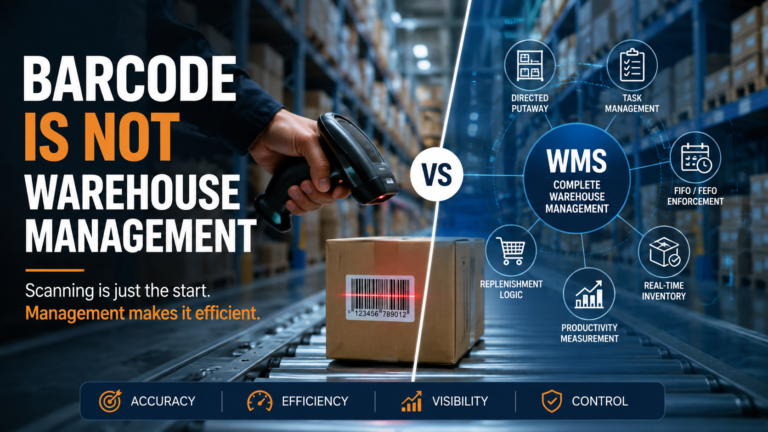
Barcode Is Not Warehouse Management

Many businesses proudly say: “We use barcode scanners, so we have warehouse management.” Unfortunately, that’s one of the biggest misconceptions in modern warehousing. Barcode scanning is an important tool, but it is only one feature of a Warehouse Management System (WMS). A barcode helps identify products. A WMS manages your entire warehouse operation—from receiving goods to dispatching orders. If your warehouse only scans products, you’re missing the capabilities that actually improve accuracy, speed, and profitability. What Is a Barcode System? A barcode system simply captures product information by scanning a printed barcode. Typically, businesses use barcode scanners to: While this is useful, barcode scanning alone doesn’t tell your warehouse what should happen next. That’s where Warehouse Management Systems come in. What Is Warehouse Management System (WMS)? A Warehouse Management System is software that plans, controls, and optimizes every warehouse process in real time. Instead of simply recording movements, a WMS makes operational decisions that improve efficiency, reduce errors, and increase productivity. Think of it this way: The barcode sees the product. The WMS decides what to do with it. 1. Directed Putaway Without a WMS, operators usually place incoming inventory wherever they find space. A Warehouse Management System automatically recommends the best storage location based on: This reduces travel time and improves picking efficiency. 2. Task Management Many warehouses still rely on supervisors giving verbal instructions. A WMS automatically creates and assigns tasks such as: Employees know exactly what to do next, improving labor utilization and reducing idle time. 3. FIFO Enforcement FIFO (First In, First Out) ensures older inventory is shipped before newer inventory. Without automation: A Warehouse Management System automatically directs workers to pick the oldest eligible stock. 4. FEFO Enforcement For industries like food, pharmaceuticals, cosmetics, and chemicals, FEFO (First Expired, First Out) is even more important than FIFO. A WMS tracks: It automatically ensures products nearing expiration are dispatched first, reducing waste and compliance risks. 5. Real-Time Inventory Visibility Many companies only discover inventory problems during monthly stock counts. A Warehouse Management System updates inventory instantly after every transaction. This provides: Real-time visibility enables better planning and faster decision-making. 6. Productivity Measurement Can you answer these questions? Most barcode systems cannot answer these questions. A Warehouse Management System tracks operational performance using KPIs such as: These insights help managers continuously improve warehouse performance. 7. Replenishment Logic Fast-moving products often run out in picking locations even when reserve stock is available. Without a WMS: A Warehouse Management System automatically generates replenishment tasks before stock runs out, ensuring pick locations remain stocked throughout the day. Barcode Scanning Records Events. WMS Controls Operations. This difference is critical. A barcode scanner records that an item moved. A Warehouse Management System decides: That’s the difference between tracking inventory and managing a warehouse. Signs You Need More Than Barcode Scanning If your warehouse experiences any of these issues, barcode scanning alone may not be enough: A Warehouse Management System addresses these challenges through automation, standardized workflows, and real-time control. Frequently Asked Questions Is barcode scanning the same as a Warehouse Management System? No. Barcode scanning is only a data capture method. A Warehouse Management System uses barcode data to automate warehouse operations, optimize workflows, and improve inventory accuracy. Can a warehouse operate with only barcode scanners? Yes, but operations remain largely manual. Barcode scanners improve data entry accuracy, while a Warehouse Management System manages receiving, putaway, picking, replenishment, inventory tracking, and labor management. Does every warehouse need a Warehouse Management System? Small warehouses may initially manage with basic barcode systems. However, as inventory, order volumes, and operational complexity grow, a Warehouse Management System becomes essential for maintaining efficiency and accuracy. What industries benefit most from WMS? Industries including e-commerce, retail, manufacturing, automotive, pharmaceuticals, food & beverage, third-party logistics (3PL), and distribution centers benefit significantly from Warehouse Management Systems. Final Thoughts Using barcode scanners is a good first step—but it is not the same as having a Warehouse Management System. If your warehouse still depends on manual decisions after scanning, you’re only capturing data—not optimizing operations. A modern Warehouse Management System transforms warehouse processes by enabling directed putaway, task management, FIFO and FEFO compliance, real-time inventory visibility, automated replenishment, and performance analytics. In today’s competitive supply chain, the real advantage isn’t scanning faster—it’s making smarter warehouse decisions.

Can Your Warehouse Handle 2X Growth Tomorrow?
Blogs

Can Your Warehouse Handle 2X Growth Tomorrow?

Growth is exciting—but it can expose weaknesses in your warehouse. Ask yourself these six questions. If you answer “no” to even one of them, your warehouse may not be ready to scale. Can You Handle Double the SKUs? Adding more products shouldn’t create confusion. A scalable warehouse lets you manage more SKUs without losing inventory visibility, increasing picking errors, or slowing down operations. Can You Process Double the Orders? When order volumes increase, your warehouse should keep up—not fall behind. If your first solution is hiring more people, it’s time to rethink your processes. Can You Manage Two New Warehouses? Business growth often means expanding to new locations. Without a centralized system, managing inventory across multiple warehouses quickly becomes complicated. A scalable warehouse provides real-time visibility across every location. Can You Track More Serial Numbers? As inventory grows, manually tracking serial numbers, batches, and stock movements becomes nearly impossible. Your warehouse should make traceability simple, accurate, and automated. Can You Deliver Faster? Customers expect faster deliveries—not longer wait times. If increasing order volumes automatically slow down your shipping process, your warehouse isn’t built for growth. Would Growth Mean Hiring More Operators? This is the ultimate scalability test. If doubling your business means doubling your workforce, you’re relying on people instead of efficient processes. Scalable warehouses improve productivity—not just headcount. The Bottom Line Growth shouldn’t create operational chaos. A modern Warehouse Management System (WMS) helps businesses manage more inventory, process more orders, handle multiple warehouses, and improve delivery speed—all without dramatically increasing operational costs. If growth means hiring more people rather than improving processes, your warehouse isn’t scalable. The right systems today will determine how confidently your business grows tomorrow.

Blogs

Invisible Inventory Loss: The Hidden Gaps in Your Warehouse Operations

Invisible Inventory Loss Introduction When inventory doesn’t match system records, the first assumption is often theft. But most audits don’t uncover stolen stock. They uncover something far more common: process gaps that quietly disrupt inventory accuracy over time. These gaps don’t show up as a single failure. Instead, they build gradually through everyday operations—small inconsistencies that go unnoticed until they become a significant financial discrepancy. What Actually Causes Inventory Discrepancies Inventory loss in warehouses is rarely dramatic. It is usually the result of multiple small breakdowns across processes. Temporary Storage Locations One common issue is temporary storage locations. Overflow areas or staging zones are often used for operational convenience but not consistently updated in the system. Over time, inventory exists physically but not digitally, creating gaps in visibility. Manual Adjustments Another frequent cause is manual adjustments. When mismatches are identified, teams often correct them directly in the system. While this resolves the immediate issue, it removes context. Without understanding why the discrepancy occurred, the same errors continue to repeat. Returns Processing Returned items are often held for inspection or reprocessing before being logged back into inventory. During this delay, they remain unaccounted for, creating inconsistencies between physical and system stock. Over-Reliance on System Data There is also a tendency to trust system data over physical reality. Once inventory is recorded, it becomes the assumed truth, even when actual stock levels may differ. This reliance allows discrepancies to grow without being questioned. Lack of Transaction-Level Traceability Without a clear record of every movement—from inbound to storage to dispatch—it becomes difficult to track where discrepancies originate. Why Loss Happens Gradually Warehouses rarely lose stock in a single day. Instead, losses accumulate through: unrecorded movements delayed updates small picking or receiving errors Each issue may seem insignificant on its own. But over time, these small differences compound into larger mismatches that are only discovered during audits. By then, the root cause is often difficult to trace. Visibility Is Not the Same as Control Many operations believe they have inventory control because they can see stock levels in their systems. But visibility alone is not enough. True control requires traceability; the ability to track every unit’s movement across the warehouse. Without it, inventory data becomes an assumption rather than a reliable source of truth. How a Warehouse Management System (WMS) Helps A Warehouse Management System (WMS) does not eliminate human error. Instead, it ensures that errors are not overlooked. It enforces structured workflows where every movement is recorded, reducing reliance on informal processes. It also creates a complete audit trail, allowing teams to trace inventory across its lifecycle. More importantly, a WMS identifies discrepancies early. Instead of discovering issues during audits, teams can address them in real time, when the context is still clear. By aligning system data with physical inventory, a WMS helps organizations move from reactive corrections to proactive control. Conclusion A single event rarely causes inventory discrepancies. They are the result of process gaps, limited traceability, and inconsistent data capture. Audits don’t create these problems; they reveal them.

Blogs

What Makes E-commerce Warehouses Different?

High Velocity. High Variability. Zero Margin for Delay. What Makes E-commerce Warehouses Different High Velocity. High Variability. Zero Margin for Delay. What Makes E-commerce Warehouses Different High Velocity. High Variability. Zero Margin for Delay. What Makes E-commerce Warehouses Different High Velocity. High Variability. Zero Margin for Delay. The Rise of the Click Economy Global e-commerce sales have crossed $6 trillion and are projected to keep growing steadily year after year. At the same time, over 60% of consumers expect delivery within 2–3 days, and a growing segment prefers same-day or next-day fulfilment. That expectation has changed what a warehouse needs to do. Traditional warehouses were designed to store goods efficiently and ship them in bulk. E-commerce warehouses are designed to process thousands of small, individual orders quickly and accurately. It’s no longer about storage. It’s about fulfilment speed and customer experience. Thousands of Small Orders, Not Bulk Shipments In a traditional B2B setup, a warehouse may dispatch pallets or cartons to a distributor. In e-commerce, the same facility could process 10,000+ single-item orders per day Key differences: Higher SKU variety Lower order quantities (often 1–3 items per order) Unpredictable order patterns Flash sales and sudden spikes This creates operational complexity. Picking, packing, and sorting become more granular and time-sensitive. Even a small inefficiency multiplies quickly at scale. Speed is the Baseline, Not the Advantage In e-commerce, speed is not a competitive edge — it’s the minimum expectation. To meet tight delivery timelines, warehouses rely on: Batch and wave picking Real-time inventory updates Defined cut-off times Fast-moving picking zones A delay of even 30 minutes can impact hundreds of orders. Operations are tightly orchestrated, often running in multiple shifts to meet demand. Returns Are Built Into the System E-commerce return rates range from 20–30% on average, and in categories like fashion, they can go even higher. Unlike traditional warehouses, where returns are occasional, e-commerce warehouses treat reverse logistics as a core process. This means: Dedicated return processing zones Quick quality inspection Fast reintegration into inventory Clear tracking and documentation If returns are not processed quickly, inventory accuracy suffers — and so does customer trust. Technology Is Non-Negotiable Manual processes cannot sustain e-commerce scale. Most e-commerce warehouses depend heavily on: Warehouse Management Systems (WMS) Order Management Systems (OMS) Barcode or RFID scanning Automation and conveyor systems Real-time dashboards Inventory visibility must be accurate down to the last unit. A single stock mismatch can lead to cancelled orders, refunds, and negative reviews. Technology is not a support function here — it is the backbone. Conclusion: It’s a Fulfilment Engine, Not Just a Warehouse An e-commerce warehouse operates less like a storage facility and more like a high-speed processing centre. It is designed around: Customer expectations Order velocity Accuracy standards Operational agility In today’s market, the warehouse is not just a backend function. It directly influences delivery speed, customer satisfaction, and brand reputation. In e-commerce, the warehouse is where the brand promise is either delivered — or broken. Book a demo now! Read More Read SCM New.

Blogs

Warehouse Myth Busting: What’s Actually Slowing You Down?

Warehousing has evolved rapidly over the last decade, yet outdated assumptions still drive many operational decisions. The result? Inefficiencies that feel “normal” but quietly drain time, money, and credibility. Let’s break down five common warehouse myths and what really happens on the floor. Myth 1: ERP Inventory = Warehouse Inventory An ERP system records ownership and transactions, what was purchased, sold, transferred, or billed.A Warehouse Management System tracks physical reality; what is actually present on the shelf, in which bin, and in what condition. When the two fall out of sync, disputes begin: Finance sees stock available. Sales promise delivery. The warehouse cannot locate the item. The mismatch between digital records and physical inventory is often the root cause of operational friction. Reality: ERP and warehouse systems must work together, but they serve different purposes. Myth 2: Barcode Scanning Slows Operations While we know that scanning only adds seconds, searching and correcting errors add hours.  Mis-picks, shipment errors, and reconciliation gaps cost far more time than the few seconds it takes to scan. Reality: Accuracy is an imperative factor, and speed alone cannot work. Structured tracking prevents invisible operational losses. Myth 3: Automation Reduces Manpower In simple words, automation’s main purpose is to eliminate chaos, it does not eliminate or replace the need for efficient manpower. When workflows are clear: Teams spend less time firefighting. Dependency on specific individuals reduces. Supervision becomes structured. Productivity per employee increases. Reality: Automation removes inefficiency in processes and structures, not employees. Myth 4: Automation Requires a Complete Operational Overhaul Many businesses hesitate to adopt automation because they assume it will disrupt existing operations or require rebuilding processes from scratch. In reality, warehouse automation can be introduced gradually, starting with simple improvements like barcode-based inward and outward tracking, followed by bin-level visibility and more controlled picking workflows. ERP integration can then align physical stock with system records. Each step strengthens operational control without halting day-to-day activities. Reality: Automation can be integrated steadily into current workflows, without a complete overhaul. Myth 5: Automation Is Only for Large Warehouses Automation is often seen as something only large warehouses need. However, operational complexity rarely comes from physical size alone — it comes from growth. As SKUs increase, order volumes rise, returns become frequent, and businesses expand to multiple locations, manual systems begin to struggle. What works in a stable, smaller setup can quickly become inefficient when scale increases. Structured systems are designed to handle that growth without creating operational strain. Reality: The right WMS scales with your operations, whether you’re mid-sized or enterprise-level. Conclusion Most operational beliefs come from habit, not data. Warehouses don’t collapse overnight.They slowly adapt to inefficiency until scale exposes the cracks. Re-examining assumptions is often the first step toward operational clarity. Book a demo now! Read More Read SCM New.

Blogs

Goods-to-Person Picking – When Walking Is Costing You Crores

In a traditional warehouse, productivity is limited by how fast a person can walk. Pickers often cover 8–12 km per shift, spending more time moving than actually picking. As order volumes grow, this “walking cost” quietly turns into lost throughput, labour inefficiency, and delayed dispatches. Goods-to-Person (GTP) picking flips this model on its head. Instead of people going to inventory, inventory comes to people — faster, smarter, and with far less human fatigue. What is Goods-to-Person Picking? Goods-to-Person is a warehouse picking strategy where automated systems deliver the required inventory directly to a fixed picking station. The picker stays in one place. The system handles movement, sequencing, and prioritisation. Some of the many common technologies used in GTP systems include: 1. Conveyors Used to transport totes, cartons, or trays from storage zones to picking or packing stations. Conveyors are ideal for high-volume, repetitive flows where speed and consistency matter. Best suited for: FMCG and retail warehouses Distribution centres with standard carton sizes 2. Autonomous Mobile Robots (AMRs) Robots retrieve shelves, bins, or totes and bring them to pick stations. Once picked, the robot returns the inventory to storage or moves to the next task. Best suited for: Dynamic warehouses with changing SKUs E-commerce and quick commerce operations Facilities needing scalability without major infrastructure changes 3. Carousels (Horizontal & Vertical) Carousels rotate inventory to present the right SKU at the right time. They significantly reduce search and travel time. Best suited for: Small to medium-sized items Spare parts, electronics, pharma, and apparel 4. Vertical Lift Modules (VLMs) VLMs store trays vertically and automatically retrieve them when required. They maximise vertical space while keeping high picking accuracy. Best suited for: Dense SKU environments Space-constrained warehouses High-value or sensitive inventory When Does a Warehouse Need Goods-to-Person? GTP is not a “nice-to-have” automation; it becomes essential when operational pressure crosses a certain point. 1. High Order Volumes As daily order lines increase, walking-based picking simply doesn’t scale. GTP systems allow warehouses to process significantly more orders per hour without proportionally increasing headcount. 2. Labour Shortages & Rising Costs Finding, training, and retaining skilled warehouse labour is increasingly difficult. GTP reduces dependence on highly skilled pickers and makes onboarding faster. Demand is volatile For products with fluctuating or unpredictable demand, order-based kitting prevents overproduction and aligns inventory directly with real orders. High SKU combinations When products can be bundled in many possible configurations, pre-kitting every combination becomes impractical. Order-based kitting offers greater flexibility. Customisation is required Customer-specific requirements, such as region-specific components or optional add-ons, are easier to manage when kits are assembled on demand. Advantages: Zero dead stock Since kits are not assembled until needed, there is no risk of unsold or outdated kit inventory. Better flexibility Warehouses can quickly adapt to changes in demand, product structure, or customer requirements, making this approach ideal for dynamic kitting solutions. Challenges: Without a robust WMS, order-based kitting can increase fulfillment time due to additional picking and assembly steps. This makes system support critical for maintaining service levels.   The Role of WMS in Kitting Operations A Warehouse Management System (WMS) is essential for executing both pre-kitting and order-based kitting efficiently within modern order fulfillment services. A WMS: Defines kit Bills of Materials (BOMs) Validates real-time component availability Guides order picking and assembly workflows Ensures inventory accuracy across both kits and components By integrating kitting logic into daily warehouse operations, WMS-powered order fulfillment solutions help reduce errors, improve speed, and deliver predictable outcomes—no matter which kitting strategy is used. Book a demo now! Read More Read SCM New.

Blogs

Pre-Kitting vs Order-Based Kitting – Choosing the Right Strategy

Kitting is the process of combining multiple SKUs into a single saleable or deployable unit. In warehouse logistics, kitting plays a crucial role in the efficiency of order fulfilment services. The choice between pre-kitting and order-based kitting has a direct impact on inventory holding, order picking speed, and customer satisfaction. Choosing the right kitting approach depends on demand patterns, product complexity, and how mature your order fulfillment solutions are. Pre-Kitting Pre-kitting involves assembling kits in advance, before customer orders are received. These kits are stored as finished units and picked like a single SKU during fulfillment. It is used for a myriad of reasons, including when: Demand is predictable Pre-kitting works best when historical data shows stable, repeatable demand. In such cases, warehouses can confidently prepare kits in advance without the risk of frequent rework. Kits have a long shelf life Products that do not expire quickly or become outdated are ideal for pre-kitting. This reduces the risk of obsolescence while allowing inventory to be staged closer to dispatch. Assembly is time-consuming When assembling a kit requires multiple steps or quality checks, doing it ahead of time reduces pressure during peak order fulfillment windows. Advantages: Faster order processing Since kits are already assembled, fulfillment teams can skip the assembly step entirely. This significantly improves turnaround time for order fulfillment services, especially during high-volume periods. Lower order picking time Pre-kitted items reduce the number of individual SKUs that need to be picked. This simplifies order picking, minimises errors, and improves warehouse productivity. Challenges: Excess inventory If demand forecasts are inaccurate, pre-kitted stock can pile up, tying up working capital and warehouse space. Obsolescence if demand changes Changes in customer preferences, regulations, or product configurations can render pre-kitted inventory unusable, leading to write-offs. Order-Based Kitting Order-based kitting involves assembling kits only after a customer order is confirmed. Components are picked individually and assembled specifically for that order. It’s used in various situations and conditions, including: Demand is volatile For products with fluctuating or unpredictable demand, order-based kitting prevents overproduction and aligns inventory directly with real orders. High SKU combinations When products can be bundled in many possible configurations, pre-kitting every combination becomes impractical. Order-based kitting offers greater flexibility. Customisation is required Customer-specific requirements, such as region-specific components or optional add-ons, are easier to manage when kits are assembled on demand. Advantages: Zero dead stock Since kits are not assembled until needed, there is no risk of unsold or outdated kit inventory. Better flexibility Warehouses can quickly adapt to changes in demand, product structure, or customer requirements, making this approach ideal for dynamic kitting solutions. Challenges: Without a robust WMS, order-based kitting can increase fulfillment time due to additional picking and assembly steps. This makes system support critical for maintaining service levels. The Role of WMS in Kitting Operations A Warehouse Management System (WMS) is essential for executing both pre-kitting and order-based kitting efficiently within modern order fulfillment services. A WMS: Defines kit Bills of Materials (BOMs) Validates real-time component availability Guides order picking and assembly workflows Ensures inventory accuracy across both kits and components By integrating kitting logic into daily warehouse operations, WMS-powered order fulfillment solutions help reduce errors, improve speed, and deliver predictable outcomes—no matter which kitting strategy is used. Book a demo now! Read More Read SCM New.

Blogs

ABC Analysis – Stop Treating All Inventory the Same

Not all inventory deserves the same attention — yet most warehouses still manage every SKU as if it carries the same risk and value. This is one of the biggest hidden causes of working-capital loss, slow picking, and excess stock. ABC inventory analysis addresses this by clearly indicating where time, space, and money should be allocated. Rather than spreading effort evenly, ABC inventory management concentrates resources on the SKUs that actually drive revenue, service levels, and cash flow. What is ABC Inventory Analysis? ABC analysis of inventory is a method of ranking SKUs based on their business impact — usually a combination of sales value, usage frequency, and revenue contribution. It groups items into three classes: Class % of Items % of Inventory Value Nature A 10–20% 70–80% High value / fast moving B 20–30% 15–25% Medium importance C 50–60% 5–10% Low value/ slow moving This form of ABC classification in inventory management reveals a critical truth: a small number of SKUs control most of the warehouse’s financial and operational impact. A-items need precision, visibility, and tight control. C-items need cost-efficient storage and simple handling. B-items sit between the two Why ABC Analysis in Inventory Matters in Warehousing Without ABC inventory management, warehouses fall into inefficient patterns: High-value items get stored next to dead stock Fast movers are buried behind slow-moving SKUs Pickers walk longer distances for critical orders Stock counts take too long and miss the riskiest items When everything is treated equally, the warehouse becomes slow, expensive, and error-prone. With ABC classification in inventory management: A-items are placed close to dispatch and high-speed pick zones B-items get moderate control and accessible storage C-items move to high-density or bulk locations This reduces travel time, protects revenue-critical inventory, and prevents over-control of low-value stock. How WMS Enables ABC A modern WMS makes ABC inventory analysis automatic and continuous. Instead of manually assigning classes, the system: Analyzes order frequency, velocity, and sales value Applies ABC analysis of inventory at SKU and location level Reclassifies products as demand shifts Aligns storage layout, pick paths, and cycle-count rules accordingly For example: A fast-selling SKU that becomes a top revenue driver is promoted to A-class A slow-moving item drops to C-class and is moved to cheaper storage This allows ABC inventory management to stay aligned with real demand, turning the warehouse from a reactive operation into a data-driven system. Conclusion ABC inventory analysis brings structure to what is otherwise chaotic inventory management. By using ABC analysis of inventory, warehouses gain clear visibility into which SKUs deserve the most attention, space, and control. Instead of spreading effort evenly across thousands of items, ABC inventory management ensures that time, money, and resources are focused where they generate the highest return. With Pyrops WMS, this becomes a living, automated system. Pyrops WMS continuously applies ABC inventory analysis using real-time movement and sales data, dynamically reclassifying SKUs as demand changes. If you want to reduce picking time, gain tighter control over your inventory, and overall have smooth functioning operations, reach out to us now! Book a demo now! Read More Read SCM New.

Blogs

Inventory Accuracy: Why Inventory Is Cash and Cash Is King

In every business that handles physical goods—retail, distribution, manufacturing, 3PL— stock management plays a far bigger role than just keeping boxes on racks. That’s why it is the single largest asset sitting inside your operation. And unlike accounts receivable or machinery, your supply is cash in its most tangible form. Which means one simple truth: If inventory is cash… and cash is king… then your warehouse is the King’s court. How well you manage stock reflects exactly how well you’re treating your king. And this starts with inventory accuracy—the foundation of both operational efficiency and financial discipline. Most businesses don’t realize this until something goes wrong—stockouts, blocked capital, shrinkage, inaccurate reports, and cash flow crunches. Besides, effective inventory management isn’t just about keeping shelves organized. It is about protecting cash, accelerating cash cycles, and ensuring the business runs with financial discipline. Here’s why proper management, backed by real-time inventory management software, is non-negotiable—and how to give your “king” the respect it deserves. 1. Inventory Management Starts with Inventory Accuracy Imagine running a business where your bank balance changes without your knowledge. That’s exactly what happens when inventory accuracy is poor. Every mismatch between physical stock and system stock creates ripple effects: Wrong replenishment decisions Excessive safety stock Lost sales due to phantom inventory Poor purchasing negotiations Most importantly, inaccurate inventory means inaccurate financial reporting. When inventory affects cash flow, not knowing the actual stock can lead to shaky finances. Therefore, a robust WMS and disciplined inventory practices, including cycle counts, location control, and scanning, ensure you always know the king’s exact worth. 2. Better Inventory Turns = Faster Cash Flow Your capital is either moving… or stuck in a carton on a shelf. And, poor visibility blocks cash and slows growth. There are many ways in which strong inventory management can help you: Forecast demand more accurately Reduce the amount of money sitting idle in inventory Improve inventory turnover Free up cash for expansion or operational needs For this reason, every additional turn improves cash flow management. 3. Controlled Inventory Reduces Shrinkage and Leakages Shrinkage is a silent killer in warehouses. It comes from: Misplacements Pilferage Inaccurate receiving Wrong picking Untracked adjustments That’s why, with proper control practices, supported by real-time inventory management software and location accuracy, every movement is logged, monitored, and accountable. 4. Operational Efficiency Improves When Inventory Is Organized Did you know that a disorganized warehouse bleeds money every minute: Staff walk more Picking takes longer Errors increase Priority orders slip Costs per order rise However, on the other hand, an organised inventory, racked systematically, stored in the right zones, and tracked in real-time, creates a warehouse that runs on precision. That’s why it’s important to recognise that inventory accuracy is not just financial; it’s an operational discipline. 5. Customer Experience Depends on Inventory Health Most customers don’t care about your constraint; they care about product availability. As a result, stockouts damage trust, incorrect orders damage reputation, and slow fulfillment damages business. However, accurate, well-managed inventory ensures: Better order fill rates Faster fulfillment Lower returns Higher service reliability Additionally, using stock replenishment strategies helps maintain the right levels of inventory to meet demand without overstocking. 6. Technology Makes Royal Treatment Possible Even the best manual processes cannot maintain accuracy at scale. As SKU counts grow, traditional Excel + ERP setups fail to keep up. Therefore, to truly “treat inventory like a king,” you need: A Warehouse Management System (WMS) Real-time inventory management software Barcode-based tracking  Location control Automated stock replenishment rules Audit logs of every movement Ultimately, technology doesn’t replace people; it elevates them. It brings discipline, visibility, accountability, and speed—all essential for maintaining the king’s stature. Final Thought: Is Your Warehouse Serving the King or Starving Him? In conclusion, it can be said that inventory isn’t a cost centre. It is an investment. It is capital. It is cash. And cash—your king—deserves structure, control, visibility, and respect. If your warehouse is still running on gut feel, manual checks, and spreadsheets, you may already be losing the king’s favour. However, with the right processes, technology, and effective inventory management, your inventory can become your strongest competitive advantage—improving cash flow management and operational efficiency while keeping your business prepared for growth.   Book a demo now! Read More Read SCM New.

Pyrops® WMS is a warehouse management software designed, developed, and implemented by Precision Pyramid Private Limited.

For more info visit: www.precisionpyramid.com

India Head Office

A-1, Forest Lane, Near Ghitorni Metro Station, MG Road, Sultanpur, New Delhi – 110030

Nepal Corporate Office

Precision Pyramid Nepal Private Limited 6th Floor, Radha Bhawan, Tripureshwar, Kathmandu, Nepal

Contacts

Follow us

Scroll to Top