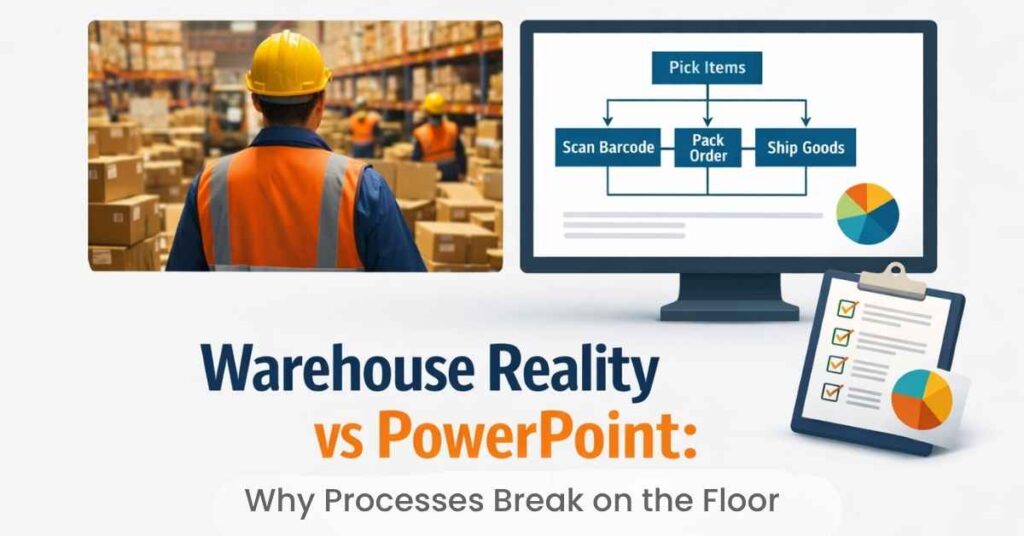
Managing multiple warehouses efficiently isn’t just about space—it’s about strategy. Are your facilities designed to scale with demand or slowing your growth?
1. Define goals & constraints
- Clarify service levels, growth plans, regulatory, and real estate limits.
- Map product-channel mix (B2B, B2C, quick commerce, etc.).
2. Gather baseline data
- Demand history, inbound patterns, inventory profiles, and layout details.
- Operating metrics: pick rates, errors, returns, and shrinkage.
3. Segment & assign roles
- Classify SKUs by velocity, value, expiry, and fragility.
- Define node types (DC, hub, cross-dock, returns center).
4. Forecast & model variability
- Build SKU-node forecasts with seasonality, promotions, safety stock.
- Stress-test peaks and disruptions.
Set a robust strategy for your mutli-warehouses with Pyrops WMS.
5. Design network & policies
- Balance central vs local stocking for cost vs SLA.
- Define replenishment triggers, allocation rules, and returns flow.
6. Space & layout planning
- Convert inventory into racking, shelving, and staging areas.
- Zone for fast-pick, quarantine, cold chain, and safety compliance.
7. Manpower & MHE planning
- Model staffing per role across peaks and shifts.
- Size forklifts, conveyors, and automation with ROI checks.
8. Technology stack
- WMS for multi-node visibility, batch/serial returns.
- Integrations with ERP, OMS, TMS, and marketplaces.
9. Processes & SOPs
- Standardize inbound, putaway, picking, dispatch, returns
- Define KPIs, exception workflows, and continuous improvement loops.
10. Simulation & costing
- Run flow simulations for peak load validation.
- Build TCO and ROI scenarios for space, MHE, and automation.
11. Implementation & change management
- Pilot → phased rollout → stabilization → expansion.
- Train workforce, appoint super-users, align KPIs.
12. Governance & scaling
- Regular KPI reviews, annual re-optimization, and risk contingencies
- Trigger expansion when utilization crosses defined thresholds.
When to call in experts
- Engage consultants for network redesign, multi-node optimization, automation ROI, or mergers/acquisitions.
- Bring specialists for WMS selection, systems integration, and discrete-event simulations.
- Use external help if you lack reliable master data, forecasting capability, or experienced project managers.
- Treat consultancy as insurance; complex networks hide interdependencies that are costly to get wrong.
Words of Caution
- Recognize complexity: small misassumptions (lead time, pick rate, seasonal spike) cascade into crippling bottlenecks.
- Don’t underestimate the change management effort, people, process, and tech must move together.
- If you aim to scale reliably, plan deliberately, and call in the right expertise early.
Breadcrumb: get help early
If you have multiple warehouses, high SKU complexity, or aggressive SLAs, arrange a professional warehouse-capacity and network review now — it pays back in avoided disruption and faster growth.