Barcode Is Not Warehouse Management
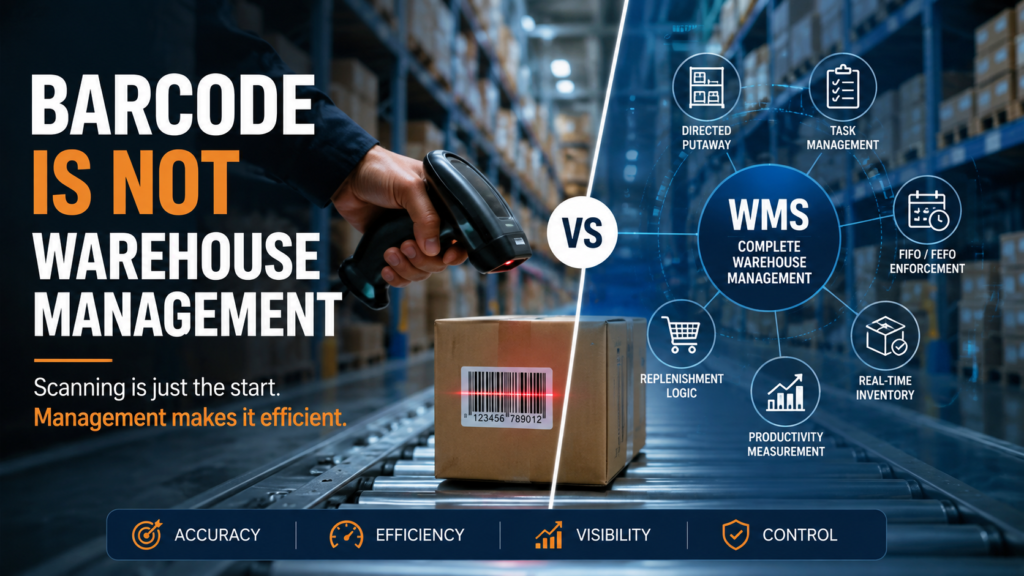
Many businesses proudly say: “We use barcode scanners, so we have warehouse management.” Unfortunately, that’s one of the biggest misconceptions in modern warehousing. Barcode scanning is an important tool, but it is only one feature of a Warehouse Management System (WMS). A barcode helps identify products. A WMS manages your entire warehouse operation—from receiving goods to dispatching orders. If your warehouse only scans products, you’re missing the capabilities that actually improve accuracy, speed, and profitability. What Is a Barcode System? A barcode system simply captures product information by scanning a printed barcode. Typically, businesses use barcode scanners to: While this is useful, barcode scanning alone doesn’t tell your warehouse what should happen next. That’s where Warehouse Management Systems come in. What Is Warehouse Management System (WMS)? A Warehouse Management System is software that plans, controls, and optimizes every warehouse process in real time. Instead of simply recording movements, a WMS makes operational decisions that improve efficiency, reduce errors, and increase productivity. Think of it this way: The barcode sees the product. The WMS decides what to do with it. 1. Directed Putaway Without a WMS, operators usually place incoming inventory wherever they find space. A Warehouse Management System automatically recommends the best storage location based on: This reduces travel time and improves picking efficiency. 2. Task Management Many warehouses still rely on supervisors giving verbal instructions. A WMS automatically creates and assigns tasks such as: Employees know exactly what to do next, improving labor utilization and reducing idle time. 3. FIFO Enforcement FIFO (First In, First Out) ensures older inventory is shipped before newer inventory. Without automation: A Warehouse Management System automatically directs workers to pick the oldest eligible stock. 4. FEFO Enforcement For industries like food, pharmaceuticals, cosmetics, and chemicals, FEFO (First Expired, First Out) is even more important than FIFO. A WMS tracks: It automatically ensures products nearing expiration are dispatched first, reducing waste and compliance risks. 5. Real-Time Inventory Visibility Many companies only discover inventory problems during monthly stock counts. A Warehouse Management System updates inventory instantly after every transaction. This provides: Real-time visibility enables better planning and faster decision-making. 6. Productivity Measurement Can you answer these questions? Most barcode systems cannot answer these questions. A Warehouse Management System tracks operational performance using KPIs such as: These insights help managers continuously improve warehouse performance. 7. Replenishment Logic Fast-moving products often run out in picking locations even when reserve stock is available. Without a WMS: A Warehouse Management System automatically generates replenishment tasks before stock runs out, ensuring pick locations remain stocked throughout the day. Barcode Scanning Records Events. WMS Controls Operations. This difference is critical. A barcode scanner records that an item moved. A Warehouse Management System decides: That’s the difference between tracking inventory and managing a warehouse. Signs You Need More Than Barcode Scanning If your warehouse experiences any of these issues, barcode scanning alone may not be enough: A Warehouse Management System addresses these challenges through automation, standardized workflows, and real-time control. Frequently Asked Questions Is barcode scanning the same as a Warehouse Management System? No. Barcode scanning is only a data capture method. A Warehouse Management System uses barcode data to automate warehouse operations, optimize workflows, and improve inventory accuracy. Can a warehouse operate with only barcode scanners? Yes, but operations remain largely manual. Barcode scanners improve data entry accuracy, while a Warehouse Management System manages receiving, putaway, picking, replenishment, inventory tracking, and labor management. Does every warehouse need a Warehouse Management System? Small warehouses may initially manage with basic barcode systems. However, as inventory, order volumes, and operational complexity grow, a Warehouse Management System becomes essential for maintaining efficiency and accuracy. What industries benefit most from WMS? Industries including e-commerce, retail, manufacturing, automotive, pharmaceuticals, food & beverage, third-party logistics (3PL), and distribution centers benefit significantly from Warehouse Management Systems. Final Thoughts Using barcode scanners is a good first step—but it is not the same as having a Warehouse Management System. If your warehouse still depends on manual decisions after scanning, you’re only capturing data—not optimizing operations. A modern Warehouse Management System transforms warehouse processes by enabling directed putaway, task management, FIFO and FEFO compliance, real-time inventory visibility, automated replenishment, and performance analytics. In today’s competitive supply chain, the real advantage isn’t scanning faster—it’s making smarter warehouse decisions.