
Warehouse Operations Simplified

Supply Chain Technology

Barcode Is Not Warehouse Management
Blogs

Barcode Is Not Warehouse Management

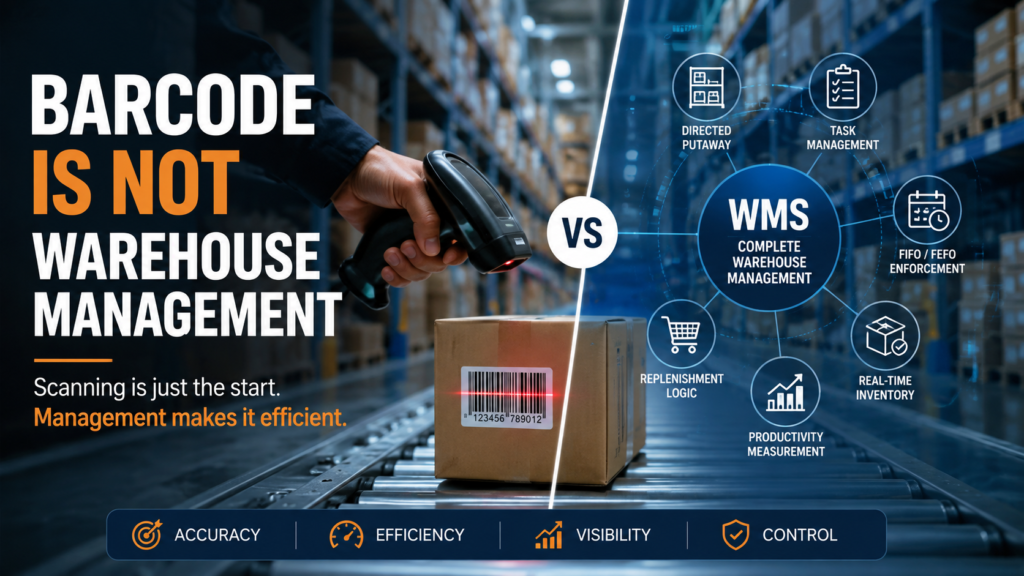
Many businesses proudly say: “We use barcode scanners, so we have warehouse management.” Unfortunately, that’s one of the biggest misconceptions in modern warehousing. Barcode scanning is an important tool, but it is only one feature of a Warehouse Management System (WMS). A barcode helps identify products. A WMS manages your entire warehouse operation—from receiving goods to dispatching orders. If your warehouse only scans products, you’re missing the capabilities that actually improve accuracy, speed, and profitability. What Is a Barcode System? A barcode system simply captures product information by scanning a printed barcode. Typically, businesses use barcode scanners to: While this is useful, barcode scanning alone doesn’t tell your warehouse what should happen next. That’s where Warehouse Management Systems come in. What Is Warehouse Management System (WMS)? A Warehouse Management System is software that plans, controls, and optimizes every warehouse process in real time. Instead of simply recording movements, a WMS makes operational decisions that improve efficiency, reduce errors, and increase productivity. Think of it this way: The barcode sees the product. The WMS decides what to do with it. 1. Directed Putaway Without a WMS, operators usually place incoming inventory wherever they find space. A Warehouse Management System automatically recommends the best storage location based on: This reduces travel time and improves picking efficiency. 2. Task Management Many warehouses still rely on supervisors giving verbal instructions. A WMS automatically creates and assigns tasks such as: Employees know exactly what to do next, improving labor utilization and reducing idle time. 3. FIFO Enforcement FIFO (First In, First Out) ensures older inventory is shipped before newer inventory. Without automation: A Warehouse Management System automatically directs workers to pick the oldest eligible stock. 4. FEFO Enforcement For industries like food, pharmaceuticals, cosmetics, and chemicals, FEFO (First Expired, First Out) is even more important than FIFO. A WMS tracks: It automatically ensures products nearing expiration are dispatched first, reducing waste and compliance risks. 5. Real-Time Inventory Visibility Many companies only discover inventory problems during monthly stock counts. A Warehouse Management System updates inventory instantly after every transaction. This provides: Real-time visibility enables better planning and faster decision-making. 6. Productivity Measurement Can you answer these questions? Most barcode systems cannot answer these questions. A Warehouse Management System tracks operational performance using KPIs such as: These insights help managers continuously improve warehouse performance. 7. Replenishment Logic Fast-moving products often run out in picking locations even when reserve stock is available. Without a WMS: A Warehouse Management System automatically generates replenishment tasks before stock runs out, ensuring pick locations remain stocked throughout the day. Barcode Scanning Records Events. WMS Controls Operations. This difference is critical. A barcode scanner records that an item moved. A Warehouse Management System decides: That’s the difference between tracking inventory and managing a warehouse. Signs You Need More Than Barcode Scanning If your warehouse experiences any of these issues, barcode scanning alone may not be enough: A Warehouse Management System addresses these challenges through automation, standardized workflows, and real-time control. Frequently Asked Questions Is barcode scanning the same as a Warehouse Management System? No. Barcode scanning is only a data capture method. A Warehouse Management System uses barcode data to automate warehouse operations, optimize workflows, and improve inventory accuracy. Can a warehouse operate with only barcode scanners? Yes, but operations remain largely manual. Barcode scanners improve data entry accuracy, while a Warehouse Management System manages receiving, putaway, picking, replenishment, inventory tracking, and labor management. Does every warehouse need a Warehouse Management System? Small warehouses may initially manage with basic barcode systems. However, as inventory, order volumes, and operational complexity grow, a Warehouse Management System becomes essential for maintaining efficiency and accuracy. What industries benefit most from WMS? Industries including e-commerce, retail, manufacturing, automotive, pharmaceuticals, food & beverage, third-party logistics (3PL), and distribution centers benefit significantly from Warehouse Management Systems. Final Thoughts Using barcode scanners is a good first step—but it is not the same as having a Warehouse Management System. If your warehouse still depends on manual decisions after scanning, you’re only capturing data—not optimizing operations. A modern Warehouse Management System transforms warehouse processes by enabling directed putaway, task management, FIFO and FEFO compliance, real-time inventory visibility, automated replenishment, and performance analytics. In today’s competitive supply chain, the real advantage isn’t scanning faster—it’s making smarter warehouse decisions.
Uncategorized

AI cannot fix operational chaos. It amplifies operational maturity.

Artificial Intelligence is no longer a futuristic concept in warehousing. It is already influencing how modern warehouses plan inventory, allocate work, optimize picking, predict delays, and improve accuracy. The real question is no longer “Should we use AI?” — it is “Are our operations ready for it?” Because AI cannot fix operational chaos. It amplifies operational maturity. AI Starts with Data Most warehouses still operate with fragmented data: AI is only as good as the quality of data it receives. If the system does not know where inventory actually is, no AI model can magically optimize operations. That is why the journey toward AI usually begins with operational digitization: Without this foundation, AI becomes expensive guesswork. Where AI Is Already Helping Warehouses 1. Smarter Inventory Planning AI can analyze historical movement patterns, seasonality, and demand fluctuations to improve replenishment and stocking decisions. Result: 2. Intelligent Picking Optimization Modern systems can dynamically optimize pick paths based on: This reduces travel time and increases throughput. 3. Labour & Resource Planning AI can predict peak loads and recommend: Instead of reacting to volume spikes, warehouses can prepare proactively. 4. Exception Prediction AI can identify operational anomalies before they become major issues: This improves control and reduces operational surprises. But Here’s the Reality… Many businesses jump directly to “AI strategy” conversations while still struggling with: AI is not the first step.Operational visibility is. A warehouse running on WhatsApp coordination and spreadsheet reconciliation cannot suddenly become “AI-enabled.” The Real Competitive Advantage The biggest value of AI in warehousing is not robotics or futuristic automation. It is decision-making speed. Warehouses generate massive operational data every day. AI helps convert that data into actionable insights faster than humans can manually analyze. Businesses that prepare early will gain: Final Thought AI will not replace warehouse teams.But warehouses using AI-assisted decision-making will outperform those that don’t. The winners will not necessarily be the companies with the most advanced technology.They will be the ones with the cleanest processes, best operational discipline, and strongest data foundation. The future warehouse is not just automated.It is intelligent. The question is — is your warehouse ready? Book a demo now! Read More Read SCM New.

WMS & ERP Integrations
Blogs

WMS & ERP Integrations

When we talk about company-wide operations and logistical planning, differentiated systems make the entire enterprise run smoothly. WMS & ERP Integrations is the backbone of wholesale & distribution companies, automating business processes and enabling the flow of information. Successful integration of a WMS with an ERP requires knowledge of the process flow and data flow within the operation. Knowing what tools an organization needs to carry out successful manufacturing, distribution, and fulfillment activities is critical to its ongoing success. Integrating such tools together into a seamless system is what makes the enterprise a well-oiled machine. Two of the most important tools in an organization’s repertoire are warehouse management system (WMS) and enterprise resource planning (ERP) software. According to Oracle, 49% of companies that utilize tools like an ERP enjoy increased productivity, and 95% saw a tangible improvement to their full range of business processes. Differences between ERP & WMS To the untrained eye, certain functions of WMS and ERP might seem alike. Understanding the benefit of full integration between the two helps to understand what each system involves. WMS (Warehouse Management System) ERP (Enterprise Resource Planning) Definition Software for tracking logistical considerations in a warehouse, including inventory management, inbound/outbound processes, capacity management, order management, and warehousing operations. Software designed to integrate operational and logistical functions of a business across the entire enterprise. Purpose To manage operations on the fulfillment side of the business. To tie all other systems together, allowing them to communicate seamlessly. Prominent Functions Inventory management, inbound/outbound processes, capacity management, order management, warehousing operations. Sales, marketing, finance, warehouse & fulfillment, and more. Information flow between WMS & ERP When integrating ERP systems and WMS it is assumed that they are different software applications but work in harmony, neither use the same platform nor designed to fulfil the same function The ERP and WMS share information continuously, and, depending on the type of data and processes, the role of each system changes The ERP system creates and maintains the master databases: it releases new products, adds suppliers and sends purchase orders to the installation, in addition to generating invoices There is also a transfer of information from the WMS to the ERP when, for example, goods are received at the warehouse or orders are dispatched  In these cases, it is the WMS that notifies the ERP and updates the inventory data It is extremely important to control this data exchange to prevent errors and information duplication through the assignment of different statuses (pending, processing, prepared, loaded, dispatched, etc.) These labels indicate to both systems which actions can and can’t be carried out, as per the rules defined For example, the WMS cannot load orders that have not been marked as “invoiced” by the ERP On the other hand, the level of detail of the information used by each system also varies For ERP users, it is probably enough to know what products are available and in what quantity on a daily basis The WMS database, however, needs to store much more concrete information, such as the location of each SKU, the type of container it’s in (pallet, box, loose units) and scheduled dispatch times Information flow required for WMS integration Normally, companies already have standardized procedures that are reflected in the ERP. As a result, the WMS has to adapt to that working methodology. Nevertheless, for the implementation of the WMS to be successful, it is crucial to provide the software provider with the following: The article master and its logistics profiles The article master includes the complete list of released products and a log of all the SKUs that the company has worked with at some point. The logistics profiles assigned to each one indicate key parameters for the management of these goods, such as size, color, expiry date, production batch (essential in pharma logistics) and hazard level, among others. Order data The ERP sends customer orders to the WMS, which must know the type of information linked to each of them. For example, both systems operate using the same order fields (name, address, etc.) and use unique codes to identify them. Therefore, if there is a mistake, and the customer needs to make a change to an order once it has been processed, the ERP executes the modification; it is then sent directly to the WMS using the fields and unique code they share. Goods receipt information The ERP sends the schedule of goods receipts to the installation, according to information provided by suppliers. This is of the utmost importance for the organization of the daily warehouse tasks, so the WMS has to be tailored to process these data correctly. Events that trigger notifications Some are already configured in the WMS by default, but the system can be personalized and adapted to other ERP requirements. For example, when there is a stock out for a particular SKU, the WMS sends an alert to the ERP How to integrate ERP & WMS? On a technical level, there are various ways to carry out the data exchange between the ERP and WMS. Let us see in brief- XML or EDI Each system uses an independent database, & therefore one way to exchange information is through data files In this method, the ERP issues messages that are read by the WMS and vice versa For both systems to communicate with each other, these files are in standardised formats, such as EDI (electronic data interchange) and the more modern and flexible XML (Extensible Markup Language) The data exchange can be done directly although there are also some ERPs that use APIs (application programming interface) to allow other software applications to communicate with them in a more agile way. Exchangeable Databases This option uses an intermediate database shared by both systems Both the ERP and the WMS update this database continuously, dumping new data into it Each software application performs periodic sweeps to check whether there are messages to process and if found any, it incorporates this new information into its

Blogs

Integration Protocols for Warehouse Supply Chain Systems

Supply chain operations are inundated with information, straining logistics centers and warehousing businesses. To address this challenge and achieve cost savings and increased customer loyalty, companies are turning to Warehouse Management Systems (WMS) software. This thesis explores the resource-based approach to WMS implementation and usage, offering a research agenda for WMS and Logistics Information Systems (LIS). Effective warehouse organization relies on resource management, adhering to established protocols for item processing and storage. Businesses must integrate their organizational components for efficient management, especially with the pressure to enhance warehousing procedures in response to market dynamics. This involves modifying value propositions and continually seeking ways to improve warehouse operations, emphasizing advanced warehouse management systems and inventory practice. Integrating disparate supply chain systems is a complex and challenging task, but it is necessary to achieve a centralized control tower, especially in the context of WMS integration and warehouse management. To overcome the challenges of integration, there are several technical methods and protocols that companies can use. In this article, we will explore some of these methods and protocols. What is the warehouse management system in SCM? Integral to logistics and supply chain operations, warehouse management system (WMS) software plays a crucial role in planning, organizing, and controlling various aspects of goods’ storage and movement within a warehouse. The primary objective is to facilitate the smooth flow of products from origin to consumption, aiming to minimize costs and maximize efficiency. Methods for achieving a centralized control tower in supply chain integration Application Programming Interfaces (APIs) APIs are a set of protocols and tools that allow different software systems to communicate with each other. APIs enable companies to connect their supply chain systems using standardized protocols, making it easier to integrate systems that were previously incompatible. Enterprise Service Bus (ESB) An ESB is a software architecture that facilitates communication between different software systems. It acts as a middleware layer between the different systems, enabling data to be exchanged in real-time. ESBs use standardized protocols, making it easier to integrate systems that were previously incompatible. Service-Oriented Architecture (SOA) SOA is a software architecture that uses services as its fundamental building blocks. These services can be accessed and combined by different applications, enabling systems to be integrated in a modular and flexible way. SOA enables companies to create a centralized control tower by connecting different  ETL is a process of extracting data from different sources, transforming it into a common format, and loading it into a target system. ETL is commonly used to integrate data from different databases, but it can also be used to integrate data from different supply chain systems. ETL enables companies to achieve a centralized control tower by consolidating data from different systems into a single data warehouse. Business Process Management (BPM) BPM is a methodology for managing and optimizing business processes. BPM enables companies to create a centralized control tower by modeling, analyzing, and optimizing their supply chain processes. BPM also provides a framework for integrating different supply chain systems into a single, streamlined process. Benefits of integrating warehouse management system in supply chain strategy Enhancing Supply Chain Efficiency: Recognizing the crucial role of warehouse management in supply chain integration is pivotal for overall supply chain efficiency. Warehouse operations are central to the movement and storage of goods, with effective management streamlining processes, reducing lead times, and enhancing responsiveness to customer demands. Cost Optimization: Insights into how warehouse management practices impact costs across the supply chain are vital. Identifying efficient strategies enables businesses to optimize costs related to inventory holding, order fulfillment, and transportation, leading to enhanced profitability. Improving Customer Satisfaction: Directly influencing order fulfillment processes, warehouse management significantly impacts customer satisfaction. A well-integrated warehouse ensures timely and accurate deliveries, minimizing errors and delays, thereby contributing to repeat business and positive brand reputation. Informing Strategic Decision-Making: As a strategic initiative, supply chain integration’s significance is communicated to decision-makers. This knowledge is essential for formulating effective supply chain strategies aligned with organizational goals and market dynamics. Technology Adoption and Innovation: Highlighting the role of technology in warehouse management and its impact on supply chain integration, the study provides valuable insights for businesses adopting innovative technologies like Warehouse Management Systems (WMS) and automation to improve efficiency and competitiveness. In conclusion, integrating disparate supply chain systems is a complex task, but there are several technical methods and protocols that companies can use to achieve a centralized control tower. These methods include APIs, ESB, SOA, ETL, and BPM. Companies must evaluate their specific needs and requirements to determine the best method for their supply chain integration efforts. With the right approach, companies can achieve real-time visibility, analytics, and decision-making capabilities for their supply chain operations Read More: Challenges of Integrating Disparate Supply Chain Systems

Pyrops® WMS is a warehouse management software designed, developed, and implemented by Precision Pyramid Private Limited.

For more info visit: www.precisionpyramid.com

India Head Office

A-1, Forest Lane, Near Ghitorni Metro Station, MG Road, Sultanpur, New Delhi – 110030

Nepal Corporate Office

Precision Pyramid Nepal Private Limited 6th Floor, Radha Bhawan, Tripureshwar, Kathmandu, Nepal

Contacts

Follow us

Scroll to Top